


(1)_edited.png)
Scar Camouflage Tattooing for Dunedin and the Surrounding Pinellas Communities

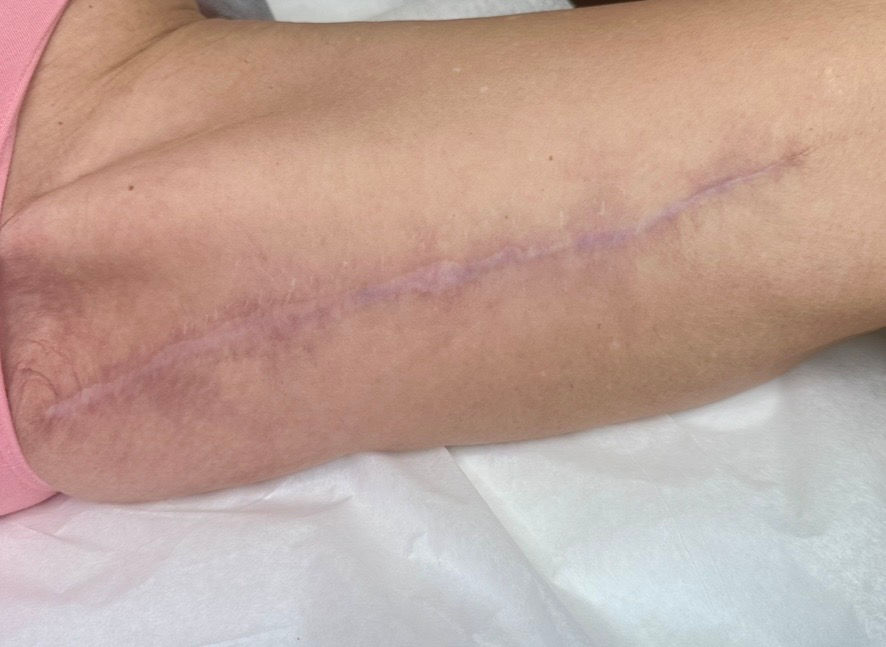
If you have been searching for how to get rid of my scar, I want to start by being honest with you about something, because I think honesty is more useful than a promise.
A scar is permanent. Once your skin has healed in that pattern, the tissue underneath is different from the skin around it, and nothing puts it back the way it was. What we can change is how visible it is. That is what scar camouflage tattooing does. I place custom-blended pigment into the scar so that it reads as your skin instead of reading as a scar. From a normal conversational distance, a well-camouflaged scar becomes something your eye passes over instead of something it stops on.
I am Bianca Cypser, and I do this work at Imagine You New in St. Petersburg, about twenty-five minutes down the road from Dunedin. I see clients from Dunedin, Palm Harbor, Safety Harbor, Clearwater, Oldsmar, Tarpon Springs and Largo every week, and the drive is usually the easiest part of the whole process.
What Scar Camouflage Actually Does
Scar camouflage is a paramedical tattoo. I am depositing pigment into the scar tissue in a controlled, layered way, matched to the skin surrounding it, so that the color difference disappears.
Most of what makes a scar noticeable is color, not texture. People assume it is the raised or indented surface that draws the eye, but in most healed scars the surface has already flattened considerably. What remains is a line or patch that is a different color than everything around it. It might be white, silvery, pink, red, purple, brown or gray. Whatever it is, it is not the color of you, and that contrast is what the eye catches.
Take the color away and the scar largely disappears, even if the texture is still there when you run your finger across it. That is why this works as well as it does.
There are two directions this can go, and I do both.
The first is hypopigmentation. This is the most common one I see, and it is where the scar has healed lighter than your natural skin. White or silvery lines from a tummy tuck, a breast lift, an arm lift, a facelift, an old injury. The scar has lost its melanin and it stays pale no matter how much sun you get. In fact, sun makes it worse, because the surrounding skin tans and the scar cannot. I rebuild color into that tissue so it comes back up to match.
The second is hyperpigmentation, where the scar healed darker than the skin around it. That one is less understood by most people, and I want to be clear that yes, I can lighten those. I work with darkened scars regularly. The approach is different from filling in a pale scar, and it takes a solid understanding of undertone to do it without going gray or muddy, but it absolutely can be corrected.
How I Match Your Color
This is the part of the work I care most about, and it is the part that separates a scar you stop noticing from a scar that now looks patched.
Skin is not one color. Your skin has a surface tone and an undertone underneath it, and the undertone is what makes a color match look real. If I matched only the surface tone, the tattoo would sit on your body looking flat and slightly off, the way a foundation shade can look correct in the bottle and wrong on the face.
I mix every color from scratch, for every single client, on the day of the appointment. Nothing comes premixed out of a bottle labeled with a skin tone. I build the color in front of you, and I show it to you as I go. You will see me swatch it, adjust it, and swatch it again. If you look at it and something feels off to you, say so, because you know your own skin and I would much rather adjust before we start than after.
I work across Fitzpatrick types one through five, and each one needs a different approach. A very fair type one has an entirely different undertone structure than a type four or five, and building color for deeper skin tones takes real attention to warmth and depth. Getting that wrong is what causes ashy or gray results, which is exactly what nobody wants. This is a skill I have spent years developing on real clients, and it is why I mix custom rather than reaching for a premade shade.
The other thing I want you to understand about color is that healing changes it. Pigment always looks more saturated the day it goes in, and it settles and softens as your skin heals over the following weeks. I plan for that. I am not matching your skin as it looks in the chair. I am matching it as it will look in six weeks. That is a judgment call that only comes from having watched hundreds of these heal, and it is why we build in layers across multiple sessions rather than trying to finish in one.
Will It Hurt
No, and I mean that.
I numb you thoroughly, and I take my time with it. I do not start until you are genuinely comfortable, and I check with you throughout. Most people are surprised by how little they feel. Scar tissue often has reduced sensation to begin with, and once the numbing is working properly, most clients describe it as a light vibration or pressure, not pain.
I have had plenty of clients tell me they were more anxious about the numbing than about the tattooing, and then relax completely twenty minutes in. Several have fallen asleep. If you have a low pain tolerance, or you have had a rough time with medical procedures in the past, please tell me at your consultation so I can plan around it. This is supposed to be the easy part after everything else you have been through.
The Scars I Work On Most
Tummy tuck scars. This is one of the highest-volume things I do. The hip-to-hip incision from an abdominoplasty is long and it sits right where a swimsuit or low waistband falls, which is exactly why people want it addressed. I also work on 360 tummy tuck scars, which wrap the full circumference of the torso. Those are a longer project because of the length, and they usually take more sessions, but they respond very well.
Brachioplasty scars. Arm lift scars run along the inner arm, often from the elbow up into the armpit. People who have had significant weight loss frequently have these, and they are visible in short sleeves and sleeveless tops all summer. In Florida that matters. These scars often heal wide and pale, and they take beautifully to camouflage.
Facelift scars. I work on facelift incisions regularly, including deep plane facelift scars, which follow the hairline and curve around the ear. Facial work is delicate and there is very little margin for error, but the incisions are usually fine and well-placed to begin with, so when they do stay visible, camouflage can make them essentially disappear. I do a lot of work on the face generally, including scars from injuries, surgeries and procedures unrelated to cosmetic work.
C-section scars. Low, horizontal, and often a different color than the surrounding abdomen. Many women live with these for decades without knowing anything can be done.
Breast surgery scars. I am going to be direct here because it matters to people looking for this. There is not any breast work I cannot do. Breast lift scars, reduction scars, the anchor pattern, the lollipop pattern, the periareolar circle, implant incisions, reconstruction scars, and full 3D areola restoration after mastectomy. Recreating the breast area is something I have done a great many times, in a great many presentations, and it is the work I am best known for. If you have been told your case is complicated, I would still like to look at it.
Stretch marks. These are scars, even though people do not always think of them that way, and hypopigmented stretch marks respond to the same camouflage principles.
Beyond that, I work on most surgical scars, injury scars, burn scars and old scars of unclear origin. If you are not sure whether yours is a candidate, send me a photo.
What to Expect
Your first appointment is a consultation. I look at the scar in good light, assess the texture, the color, the maturity of the tissue and how it is likely to take pigment. We talk about how many sessions it will realistically need and what a good outcome looks like for your specific scar, because that varies.
The scar needs to be fully mature before we start. That is generally at least twelve months post-surgery, sometimes longer. Working on a scar that is still actively remodeling gives unreliable results, because the tissue is still changing underneath you. If you come to me early I will tell you to wait, and I would rather do that than take your money and give you an unpredictable result.
Once we begin, sessions are typically spaced six to eight weeks apart. Each session builds on the last. Most scars take two to four sessions, though longer scars like a 360 or a full brachioplasty can take more. I build gradually and conservatively, because it is easy to add more pigment at the next session and much harder to take pigment away.
Aftercare is straightforward. Keep it clean, keep it moisturized, and keep it out of the sun. Sun is the enemy of this work both before and after, so plan on sunscreen over the area indefinitely. On the Gulf coast that is worth saying twice.
Why Dunedin Clients Come to St. Petersburg
Dunedin is a short drive down 19 or across the Bayside, and honestly, most clients tell me the drive is nothing compared to what it took to get to this point.
This is a specialty. Scar camouflage is not something a general tattoo artist or a standard permanent makeup studio typically offers, because it requires understanding how scar tissue behaves, how pigment settles into damaged skin differently than into healthy skin, and how to build custom color across a wide range of skin tones. It is a much smaller field than people expect.
I am in the treatment room with clients every week, working on exactly these cases. That daily practice is what keeps the color work sharp.
Cost and Insurance
Pricing depends on the size of the scar, its condition, and how many sessions it will need, which is why I quote after a consultation rather than posting a flat price. I would rather look at your scar and tell you the truth than give you a number that turns out to be wrong.
For areola restoration following mastectomy, insurance sometimes covers the procedure. Post-mastectomy reconstruction, including nipple and areola restoration, is a covered benefit under federal law through the Women's Health and Cancer Rights Act, though how each individual plan handles a tattoo artist as the provider varies quite a bit. I can provide a superbill with the appropriate procedure codes for you to submit to your insurer. Coverage for general cosmetic scar camouflage is much less common, but if your scar is connected to a reconstructive procedure it is worth calling your plan and asking.
Booking
Imagine You New, 4137 5th Ave. N., St. Petersburg, FL 33713. Call or text 727-504-4664. imagineyounew.com
If you are in Dunedin, Palm Harbor, Safety Harbor, Clearwater, Oldsmar, Tarpon Springs or anywhere in Pinellas County and you have a scar you are tired of looking at, send me a photo and I will tell you honestly what I think we can do with it. If I do not think camouflage is the right answer for your scar, I will tell you that too.
Questions and Answers
How far is your studio from Dunedin?
Imagine You New is at 4137 5th Ave. N. in St. Petersburg, roughly twenty-five to thirty-five minutes from Dunedin depending on traffic and your route.
Does scar camouflage actually remove the scar?
No. The scar tissue itself is permanent. What changes is the color, so the scar blends into your surrounding skin and stops catching the eye. Most people find that once the color difference is gone, they stop noticing the scar entirely.
Does it hurt?
Very little. I numb the area thoroughly before starting and check with you throughout. Most clients describe it as pressure or vibration rather than pain, and scar tissue often has reduced sensation to begin with.
How long do I have to wait after surgery?
Generally at least twelve months, sometimes longer. The scar needs to be fully mature and no longer changing. If you come in sooner, I will assess it and tell you honestly whether it is ready.
Can you fix a scar that healed darker than my skin?
Yes. Hyperpigmented scars can be lightened. It is a different technique than filling in a pale scar and it takes careful attention to undertone, but it is very much something I do.
Do you work on darker skin tones?
Yes. I work across Fitzpatrick types one through five and mix every color from scratch for each client. Building correct warmth and depth for deeper skin tones is a specific skill, and it is one I have developed on real cases over many years.
How many sessions will I need?
Most scars take two to four sessions spaced six to eight weeks apart. Longer scars, such as a 360 tummy tuck or a full arm lift, generally take more. I will give you a realistic estimate at your consultation.
What kinds of scars do you treat?
Tummy tuck and 360 tummy tuck scars, C-section scars, brachioplasty scars, facelift scars including deep plane facelift incisions, breast lift and reduction scars, reconstruction scars, areola restoration, stretch marks, injury scars and most surgical scars. If you are unsure, send a photo.
Will insurance cover it?
Sometimes, for areola restoration after mastectomy. I can provide a superbill with the appropriate codes for you to submit. Coverage for general cosmetic scar camouflage is uncommon, but worth asking your plan about if your scar relates to a reconstructive procedure.
How do I get started?
Text or call 727-504-4664 with a photo of the scar in natural light. I will tell you honestly whether camouflage is the right approach for it.

I enjoyed reading this post because the ideas are explained clearly and without unnecessary complexity. It encouraged me to look into related content, where I found jaya 9. Having another source to explore can be helpful when learning about online entertainment and interactive digital content.
I appreciate the emphasis on undertone matching rather than just surface color. It makes sense that a flat match would look like a patch. My question is about the healing process: since tattooed pigment can shift as the skin settles, how do you account for that when building the color initially? Do you deliberately aim slightly lighter or warmer, or is the final result stable enough that no adjustment is needed? I'm curious how much of the outcome depends on the initial session versus a follow-up.
See also: https://animebreaker.org/