


(1)_edited.png)
Knee Incision Scar Camouflage in St. Petersburg, FL

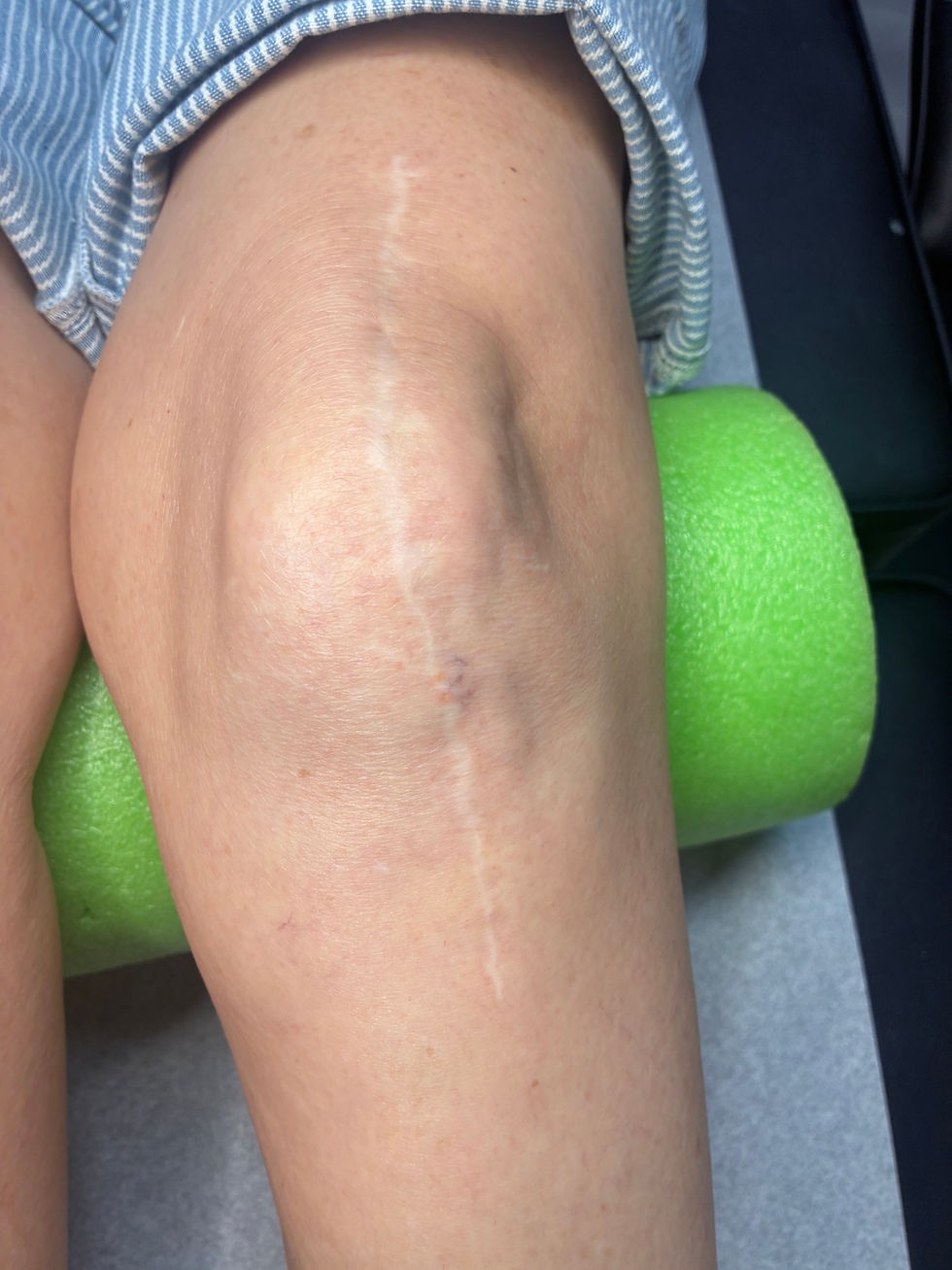
Your Knee Scar Can Be Taken Care Of
Some of the most grateful clients I have ever had came in for a knee scar. A lot of them have lived with that line down the front of their knee for years. Some for ten years, some for twenty, some since they were teenagers. They stopped wearing shorts. They stopped wearing dresses. They got used to pulling a blanket over their legs when they sit down. And then they find out that this scar can be taken care of, and they can't believe they waited so long.
I'm Bianca Cypser, and I do paramedical tattooing and scar camouflage at Imagine You New in St. Petersburg, Florida. Knee incision scars are something I see all the time, from knee replacements, ACL surgeries, kneecap repairs, and old injuries. This article is everything I want you to know about how I approach them and what to expect.
The short answer is yes, a knee scar can be camouflaged. It takes some sessions, it takes building up color, and it takes blending out the edges. But this is a scar that can definitely be taken care of.
Why Knee Scars Stand Out So Much
The knee is one of the hardest-working joints in your body. Every time you walk, sit, climb stairs, or kneel, the skin over the front of your knee stretches and relaxes. An incision that heals in a spot like that is under tension the whole time it is healing, so knee scars often end up wider, whiter, and shinier than scars in other places.
Most knee scars I see are lighter than the skin around them. The scar tissue doesn't make pigment the way normal skin does, so it shows up as a pale or white line, and it stays that way even when the rest of your leg tans. In the summer, that line gets even more obvious. Florida sun makes your legs darker and the scar just sits there, white, right down the center of your knee.
The photo on this page is a good example. It's a long vertical incision down the front of the knee that healed white, with a few spots along the line that are a little different in color. The eye follows that line from top to bottom. My job is to bring that line back to the color of the skin around it so the eye doesn't stop there anymore.
The Different Knee Surgeries and the Scars They Leave
Not every knee scar is the same, and the type of surgery you had tells me a lot about what I'm going to be working with. Here are the ones I see most.
Total Knee Replacement
This is the big one. A total knee replacement usually leaves a long vertical scar down the front of the knee, starting above the kneecap and running down past it toward the shin. Some surgeons make the incision straight down the middle, and some curve it slightly along the inside edge of the kneecap. A traditional knee replacement incision is often around eight to ten inches long, and newer smaller-incision techniques are often closer to four to six inches. Either way, it is a long line right on the front of your leg, and it's the knee scar I camouflage most often.
Partial Knee Replacement
When only one part of the knee is replaced, the incision is usually shorter, but it's still on the front of the knee and still very visible in shorts or a skirt.
ACL Reconstruction
ACL scars depend a lot on when you had the surgery. Clients who had their ACL repaired years ago often have one long scar down the front of the knee, sometimes wide and wrinkly. Newer ACL surgeries are usually done with a scope, so the scars are smaller, but there is often still a scar below the kneecap or on the inside of the upper shin where the surgeon took tissue for the graft. Those graft scars are usually the ones people want camouflaged.
Arthroscopic Knee Surgery
Meniscus repairs and cleanups are often done with a scope through a few small openings around the kneecap. These leave little round or short scars, usually one on each side of the kneecap. They're small, but a white dot on each side of your knee can still bother you, and they usually camouflage quickly.
Kneecap and Fracture Repairs
Broken kneecaps and fractures around the knee are often repaired with plates, screws, or wires, and those incisions can be long and sometimes run along the side of the knee instead of the front. Clients who had more than one surgery on the same knee sometimes have two scars, or one scar that was reopened and healed wider the second time.
Injury Scars
Not every knee scar comes from surgery. Falls, bike accidents, sports injuries, and childhood scrapes that healed white can all be camouflaged the same way.
Smooth Knee Scars vs. Knee Scars With Depth
This is the biggest thing I look at when you come in, and it decides how I'm going to approach your scar.
Some knee scars are really smooth. They're flat, they don't have ridges, and when you run your finger over them you can barely feel them. The only real problem is the color. These scars take color in a more even way, and they're usually the faster ones to camouflage.
Other knee scars have more depth to them. They might be sunken in, they might have ridges or texture, or they might be raised in some spots and dipped in others. That's a different type of scar. Scar tissue with depth and ridges takes color differently, so it takes longer to build the color up, and it needs more sessions.
The texture of your scar determines how I mix the ink and how I work the scar. A smooth scar and a ridged scar on the same skin tone might get different mixes and a different approach. I'm not just matching the color of your leg. I'm matching it in a way that works with the scar tissue I'm putting it into.
A lot of knee scars are a mix of both. The part over the kneecap might be smooth and shiny, and the part lower down might be deeper or more textured. I work each section of the scar the way that section needs.
How I Camouflage a Knee Scar
Scar camouflage is a paramedical tattoo technique. I tattoo skin-toned pigment into the scar so it matches the skin around it. The goal is to cover the scar so it blends into your leg.
I mix every color by hand for each client. Your leg isn't one flat color. There are warm spots, cool spots, freckles, and little color changes from your thigh down to your shin. The skin right over your kneecap can even be a different tone than the skin beside it. I match what's actually there instead of laying one beige color down the whole line.
If there are spots along the scar that are darker or a different color, like the small spot you can see in the photo, I correct those too so the whole line ends up even.
Building Up the Color Takes Time
I build the color in stages. The first session lays in the base color and starts bringing the scar closer to your skin. Each session after that adds more color where it's needed, softens the scar, and gets more detailed.
Scar tissue takes color more slowly than normal skin, and a knee scar is no different. It takes some time to build the color up, and the deeper, ridged scars take longer than the smooth ones. That's normal, and it's exactly why I do this in layers instead of trying to do it all at once.
For most scars, smaller ones take up to three sessions, and large ones take about four to six. A full knee replacement scar is a large scar, so plan on the longer side. My sessions are usually about a month apart, and about six weeks apart when I'm doing lightening work.
Blending Out the Edges
The edges are where camouflage either works or doesn't. If you can see a hard line where the scar stops and your skin starts, the scar is still there. So a big part of every session is blending out the edges, softening the border of the scar into the skin around it so there's no outline left.
On a long knee scar that means blending the full length of it, from the top above the kneecap to the very end on the shin, and following every curve the incision takes. By the last session, the goal is a knee that just looks like a knee.
One Knee or Both Knees
Some clients come in with one knee, and some come in with both. A lot of people who have one knee replaced end up having the other one done a few years later, so they have two scars that might be different ages and might have healed completely differently.
If you have both knees, I look at each scar on its own. One might be smooth and one might have more depth. One might be older and whiter. I plan each knee the way it needs, and when we're done I want both knees to look even with each other, not just with the skin around them.
It Doesn't Matter How Old Your Scar Is
People are always surprised by this. A knee scar you've had for fifteen or twenty years can be camouflaged. Old scars are actually great to work with because they're fully settled and they're not changing anymore.
For newer surgeries, your scar should be about a year old before we start, so it's fully healed and the color has settled. If you're not sure whether yours is ready, come in for a consultation and I'll look at it.
The clients who have carried a knee scar for years are the ones who get emotional at the end. Being able to put on shorts or a dress without thinking about your knee is a big deal, and I love being part of that.
What to Expect at Your Appointment
Everything starts with a consultation. I look at your knee in person, feel the texture of the scar, check whether it's smooth or has depth, look at your skin tone and undertone, and we talk about what you want. The consultation is $75, and that amount is credited toward your procedure.
If you want to see how your skin takes the color first, I can do a test spot. It's not required, it's just there if you want it.
Healing is easy. Most clients go right back to their normal routine, and the area heals in about two to five days. I give you aftercare instructions to follow between sessions. Wearing loose shorts or pants to your appointment makes it more comfortable for the ride home.
Clients From St. Pete, Tampa, Clearwater, and Sarasota
My studio is in St. Petersburg, Florida, and I see knee scar clients from all over St. Pete, Tampa, Clearwater, and Sarasota, plus clients who drive in from much farther. I have hundreds of documented client cases at Imagine You New, and scar camouflage is the work I do every day.
If your knee scar has kept you out of shorts, dresses, or bathing suits, you don't have to keep hiding it. It can be taken care of, and I would love to help.
Book Your Knee Scar Consultation
Imagine You New
4137 5th Ave N, St. Petersburg, FL 33713
727-729-9069
imagineyounew.com
Frequently Asked Questions
Can a knee replacement scar be camouflaged?
Yes. I tattoo skin-toned pigment into the scar, build the color up in sessions, and blend out the edges so the scar matches the skin around it.
How many sessions does a knee scar take?
Smaller scars take up to three sessions, and large scars like a full knee replacement take about four to six. Scars with more depth or ridges take longer to build color than smooth scars.
Why do scars with depth take longer?
Scar tissue with ridges or depth takes color differently than smooth, flat scar tissue, so I build the color more gradually and adjust how I mix the ink and approach the scar.
Can you camouflage scars on both knees?
Yes. I plan each knee on its own because the scars can be different ages and textures, and I make sure both knees end up looking even.
Can you camouflage an old knee scar?
Yes. Scars that are many years old are great to work with because they are fully settled. Newer surgical scars should be about a year old before we start.
Can you camouflage ACL and arthroscopy scars?
Yes. ACL graft scars and the small scars from scope surgery around the kneecap camouflage well, and the small ones usually take fewer sessions.
How long does healing take?
Most clients go right back to their normal routine, and the area heals in about two to five days.
Where is your studio?
Imagine You New is in St. Petersburg, Florida. I see clients from St. Pete, Tampa, Clearwater, Sarasota, and beyond.

I appreciate how you explained that knee scars often heal wider and whiter because the joint is under constant tension. That makes me wonder: does the camouflage color hold up over time as the skin continues to stretch with daily movement, or do clients typically need periodic touch-ups to maintain the blend? It seems like a spot that's always flexing would be harder to keep looking natural than a scar on a more static area.
Useful reference: https://worksheetgenerator.org/
Spider-Man has such an iconic visual identity that his costume is instantly recognizable to fans around the world. The Spider-Man Brand New Day 2026 Tom Holland Suit gives enthusiasts an opportunity to celebrate that character through fashion. I can see it being particularly interesting for cosplay enthusiasts, collectors, and people attending superhero-themed events.