


(1)_edited.png)
HOW TO AUTHENTICATE MEDICAL TATTOO WORK IN TAMPA: WHAT TO LOOK FOR BEFORE YOU BOOK

If you're searching for a paramedical tattoo artist in Tampa right now, you've probably noticed something: everyone's portfolio looks impressive on a screen. Reviews are five stars. Photos look professional. And with how easy it's become to buy reviews from third-party services, borrow images, or pay for a magazine feature, it's genuinely hard to tell who actually does this work and who's just presenting themselves as if they do.
I've been in this industry for a long time, and I want to be honest with you about something most people won't say out loud: this is a real problem in paramedical tattooing right now. Not because people are inherently dishonest, but because in the age of AI and the internet, you can present yourself as anything you want to be. Someone can call themselves a top medical tattoo artist, get featured in a publication, and build a following without ever having done the work themselves. That's not illegal, and honestly, everyone has the right to put themselves out there however they choose. But if you're the one considering a procedure this personal, you deserve to know how to look a little deeper.
This matters more here than in most beauty services because of who's actually booking these procedures. You may be coming to this after breast cancer. After a mastectomy. After a tummy tuck, a facelift, a C-section that left a scar you think about every day. This is not a casual purchase. It deserves real scrutiny, not because you should be suspicious of everyone, but because you owe it to yourself to know the difference between real, honest work and a well-built presentation.
START WITH THE PORTFOLIO, NOT THE REVIEWS
Reviews are the easiest thing in this industry to fake. There are companies that sell Google reviews. That's not a rumor, it's something you can actually buy right now. So a page full of five-star reviews tells you very little on its own.
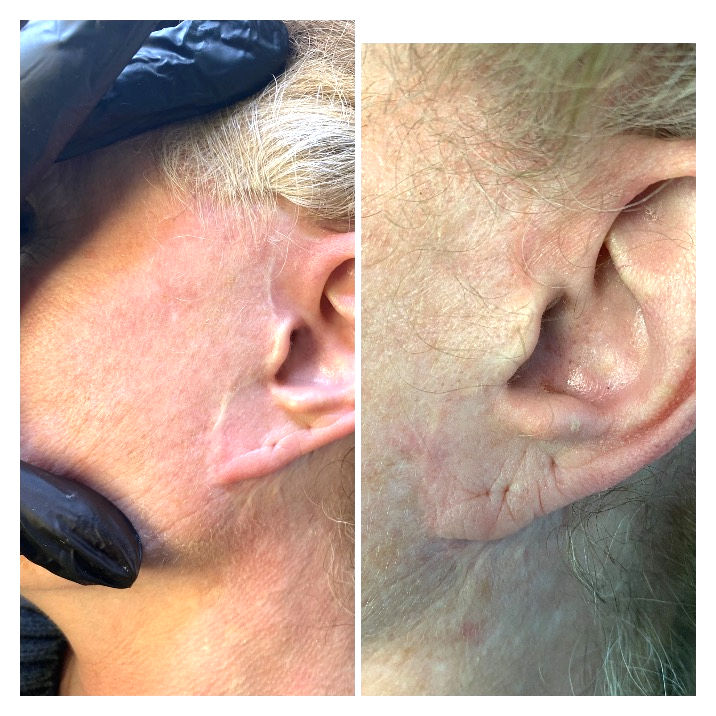
A portfolio is different. If someone has been doing this work for real, they'll have before-and-after photos to show it, and how many you need to see before you feel comfortable is entirely up to you. Some people see one result and know immediately that's the artist they want. That's okay. There's no magic number. What matters is that the portfolio actually exists, that it's substantial, and that it looks like it came from real sessions with real clients rather than a handful of borrowed images.
If someone has dozens of reviews but little to no visible before-and-after work, that's worth noticing. Real work leaves a real trail.
USE REVERSE IMAGE SEARCH
This is the single most useful tool you have. Take any before-and-after photo from a website or Instagram page and run it through Google Lens. If that exact photo shows up on other websites, under other names, that's a red flag.
To be fair, it doesn't automatically mean the photo was stolen. Sometimes an original artist's own work gets reposted elsewhere without credit. But if you're seeing the same image tied to multiple different "artists" or businesses, that's a mismatch worth paying attention to before you book.
WATCH FOR BORROWED AUTHORITY, NOT JUST BORROWED PHOTOS
Photos aren't the only thing people can buy or manufacture. Paid magazine placements, purchased media features, and self-appointed titles like "top" or "leading" medical tattoo artist can all be arranged without a single documented case behind them. None of that is against the law, and people are free to market themselves however they want. But a title or a feature isn't the same as a body of real, verifiable work.
This is where I'd ask you to look for the match. Does the story someone is telling about their experience line up with what you can actually see? If the answer is a real, visible portfolio, honesty about how long they've been doing this specific procedure, and results that hold up under a second look, that's someone worth trusting. If there's a gap between the claim and what you can verify, that gap is the thing to pay attention to.
AN INDUSTRY PROBLEM WORTH NAMING: TRAINERS, NOT JUST ARTISTS
There's a layer to this that goes beyond individual artists booking clients. Some people teaching paramedical tattooing to others have never actually done meaningful work themselves, and are certifying new artists under their name without a real portfolio to back up what they're teaching.
Again, I want to be fair here. Being new to the field isn't a problem, and nobody starts with decades of experience. What matters is honesty about where someone actually is in their journey, whether they're training you or working on you. A new artist who's upfront about their experience is trustworthy. A trainer or artist who presents themselves as an authority they haven't earned, while working on real clients or certifying other real artists, is a different situation entirely.
WHAT THIS ACTUALLY COMES DOWN TO
None of this is about tearing anyone down or saying people can't present themselves however they want. They can. That's not the issue. The issue is that when you're the one considering this procedure, especially after something as significant as cancer, surgery, or an injury, you deserve to look a little closer and see if what's being shown to you actually matches what's real.
Look at the portfolio. Reverse image search the photos. Don't take reviews at face value. And ask yourself honestly whether the story adds up. That's really all this comes down to.
FAQ SECTION:
Q: Can I trust an artist's before-and-after photos if I've never met them in person?
A: Photos are a good starting point, but verify them with a reverse image search in Google Lens. If the same photo appears on other sites under different names, treat that as a reason to ask more questions before booking.
Q: Do a lot of five-star reviews mean an artist is legitimate?
A: Not on their own. Reviews can be purchased from third-party services, so a high review count doesn't replace a real, visible portfolio of actual client work.
Q: Is it a bad sign if an artist is new to paramedical tattooing?
A: No. Being new isn't the problem. What matters is honesty about experience level. A new artist who's upfront about where they are in their career is more trustworthy than someone who overstates experience they don't have.
Q: How many before-and-after photos should a legitimate artist have?
A: There's no fixed number. What matters is that the portfolio is real, substantial, and reflects actual client outcomes rather than a small handful of borrowed or stock images.
Q: Are paid magazine features or media placements a reliable way to judge an artist?
A: Not by themselves. Media placements can be purchased and don't necessarily reflect documented, real client work. Look for a portfolio and track record that back up any credentials or features.


Comments