


(1)_edited.png)
One Session of Dark Scar Camouflage Healed From a Tummy Tuck Scar
- Bianca Cypser
- 21 hours ago
- 10 min read

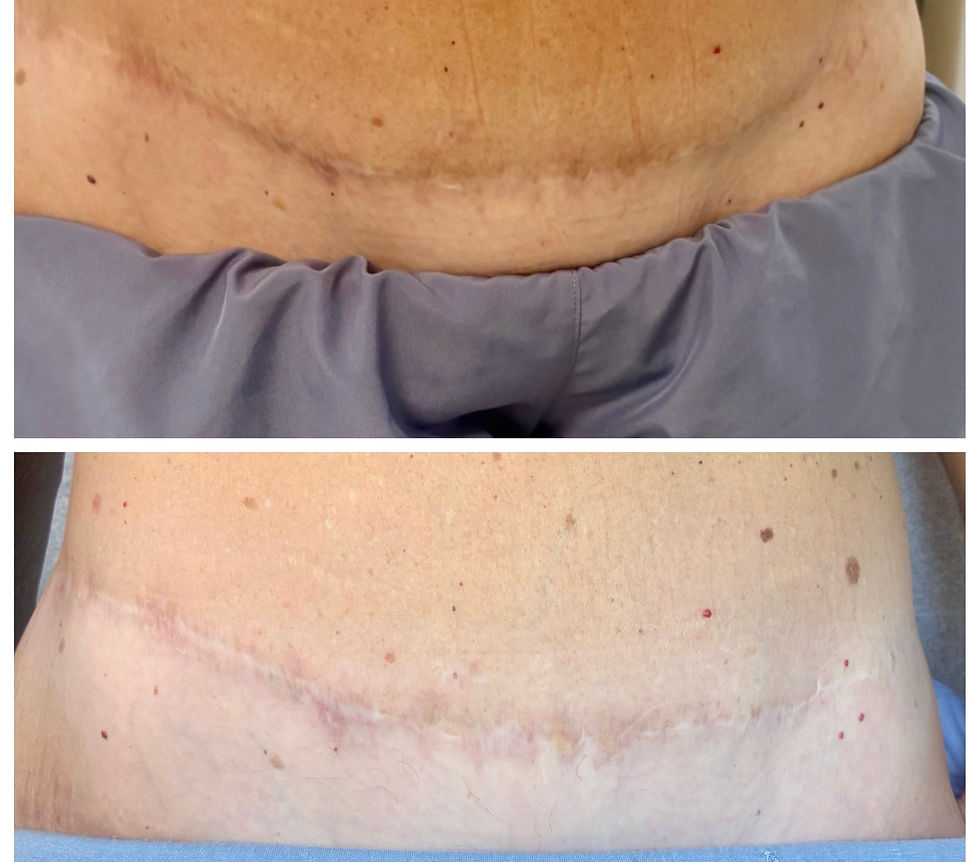
A tummy tuck scar that healed dark is one of the most common concerns we hear about at Imagine You New in St. Petersburg, Florida. The surgery went well. The shape looks good. But the line across the lower abdomen healed brown, gray, or deep reddish purple, and it shows through swimwear, low rise jeans, and anything that sits below the waist. It becomes the one thing a person sees in the mirror.
This article walks through what a dark tummy tuck scar actually is, why it happens, how scar camouflage tattooing covers it, and what one healed session can realistically look like. Everything here comes from real client work done in our St. Petersburg studio, serving clients from Tampa, Clearwater, Sarasota, and across the Gulf Coast.
What a Dark Tummy Tuck Scar Really Is
A tummy tuck scar runs horizontally across the lower abdomen, usually from hip to hip, placed low so it sits under clothing. Most people also have a second scar around the belly button where it was repositioned. On extended and fleur de lis procedures there may be a vertical line running up the center of the abdomen as well.
When that scar heals darker than the skin around it, that is post inflammatory hyperpigmentation. The healing process triggered extra melanin production along the incision line, and the pigment stayed. Instead of fading toward the surrounding skin tone the way a scar is supposed to, it settled into a darker band.
Hyperpigmented scars can look brown, tan, gray, mauve, deep purple, or reddish brown depending on skin tone and how long ago the surgery was. They are extremely common in medium and deeper skin tones, and they are also common in fair skin that tans easily. They tend to be more noticeable than raised texture, because the eye reads color contrast before it reads surface change.
The scar in the photo attached to this article is a good example. Before treatment, the line across the lower abdomen was significantly darker than the surrounding skin, with color variation running along the entire length. After one healed session of scar camouflage, the color contrast is dramatically reduced and the line blends into the skin around it.
Why Tummy Tuck Scars Heal Dark
There is no single cause, and in most cases it is a combination of factors.
Sun exposure during healing is the biggest one, and it is the one people underestimate. A fresh scar has no natural sun protection. Even indirect exposure through a car window or a thin shirt on a Florida afternoon can drive pigment into a healing incision permanently. This is why we see so many hyperpigmented tummy tuck scars in St. Petersburg, Tampa, and Sarasota specifically. The climate works against a healing scar.
Skin tone matters. Fitzpatrick types three, four, five, and six produce more melanin in response to injury. That is normal biology, not a flaw, but it means darker pigmentation after surgery is more likely.
Tension along the incision line plays a role. A tummy tuck closure is under real tension because tissue is being pulled downward and secured. Tension changes how the scar matures and can contribute to both color change and texture change.
Inflammation during healing contributes as well. Delayed healing, minor separation along the incision, irritation from garments or tape, or any infection extends the inflammatory phase, and a longer inflammatory phase means more pigment deposit.
Hormones can be part of it. Pregnancy, hormonal birth control, and perimenopause all influence melanin activity, and many tummy tuck patients are in exactly those windows.
Genetics is the piece nobody can control. Some people simply scar with more color than others, and family history is often the best predictor.
How Long to Wait Before Treating a Dark Tummy Tuck Scar
A scar has to be fully healed and mature before it can be tattooed. That generally means twelve months from the date of surgery, though some scars are ready at nine to ten months and some need longer.
Fully closed is the minimum requirement. There can be no scabbing, no open areas, no drainage, no tenderness, and no active healing happening. Beyond that, the scar needs to be settled. A scar that is still actively changing color on its own will keep changing after tattooing, and that undermines the color match.
Waiting also gives natural fading a chance to happen. Some hyperpigmentation lightens on its own over the first year. Treating too early means matching pigment to a color that is still in motion.
If there is any doubt, we look at the scar in person during consultation and give an honest answer. If it is not ready, we say so and set a time to look again.
How Scar Camouflage Tattooing Works on a Dark Scar
Scar camouflage tattooing places custom blended pigment into the scar tissue to reduce the contrast between the scar and the skin surrounding it. The goal is blending, not erasing. A camouflaged scar is still there. It simply stops announcing itself.
Working on a hyperpigmented scar is different from working on a light or hypopigmented one, and this is where technique matters most.
With a white or hypopigmented scar, the scar has lost pigment, and tattooing puts color back. It is an additive process, and the result can be very close to seamless.
With a dark scar, the scar already has too much color. Adding pigment on top of pigment can make it darker, muddier, or gray. The work is about neutralizing and balancing rather than covering. It requires reading the undertone in the scar accurately, whether it is running red, purple, gray, or brown, and selecting pigment that counteracts that undertone while still matching the surrounding skin tone.
This is color theory applied to skin. A scar running purple needs different correction than a scar running olive brown. Getting that wrong is what produces the gray, ashy, patchy results people are afraid of. Getting it right is what produces the kind of blend shown in the photo with this article.
Every pigment blend here is mixed for the individual client. There is no shade chart pulled off a shelf. Skin tone is assessed in natural light, undertone is identified, and the blend is built and tested before the full pass begins.
What One Session Actually Looks Like
The photo attached to this article shows one healed session. That is worth saying clearly, because most results people see online are either fresh, before healing, or after multiple sessions.
Consultation and color matching come first. We look at the scar in natural light, identify the undertone, and build the pigment blend. A small test area may be placed to confirm the match before proceeding.
Numbing is applied. Most clients describe the sensation as mild. Scar tissue often has reduced sensation compared to normal skin, and many people find a tummy tuck scar easier to sit through than they expected.
The pigment is worked into the scar in passes, following the line of the incision and feathering into the edges so there is no hard border between treated and untreated skin. That feathering is what makes the work look natural rather than drawn on.
Session time depends on scar length. A full hip to hip tummy tuck scar typically runs two to three hours.
Immediately after, the area looks darker and more saturated than the final result. This is normal and expected. It is not the outcome.
Then it heals. Over the following four to six weeks the pigment settles, the surface exfoliates, and the true color emerges. This is when the blend becomes visible. Most people lose some percentage of the pigment during healing, which is exactly why the process is built around multiple sessions.
After one healed session, a meaningful reduction in contrast is a realistic expectation. The scar is noticeably less visible and blends much more closely with the skin around it, as shown in the photo with this article.
Why Multiple Sessions Are Standard
Most scars need two to four sessions spaced six to eight weeks apart.
Skin does not accept all of the pigment on the first pass. That is normal behavior, not a mistake. Scar tissue is denser and less predictable than normal skin, and it holds pigment inconsistently along its length. Some sections take beautifully. Some take lightly and need another pass.
Each session builds on the last. The first session establishes the base and shows how that individual scar responds. The second refines the match and evens out any areas that took lightly. Additional sessions fine tune from there.
Anyone promising a complete result in a single session is not describing how skin actually behaves. Working in layers is what protects the outcome, because pigment can always be added but it cannot easily be taken away.
What Scar Camouflage Does Not Do
Being straightforward about this matters more than making a sale.
Scar camouflage addresses color. It does not change texture. If a tummy tuck scar is raised, indented, or rope like, it will still have that texture afterward. Color blending often makes texture less noticeable, because reduced contrast means less shadow, but the surface itself does not change.
It does not remove the scar. The scar is permanent. Camouflage reduces how much it stands out.
It is not a substitute for medical treatment of an active or problematic scar. Keloids, hypertrophic scars that are still thickening, and scars with ongoing complications need a physician first.
Results vary. Skin tone, scar age, undertone, how the scar healed, sun history, and individual healing all influence the outcome. Some scars blend beautifully. Some blend well. A small number are limited by what the tissue will accept.
Other Abdominal Scars We Work On
The same approach applies to related scars, and many clients have more than one.
C section scars are the most common. They are shorter than tummy tuck scars, sit lower, and frequently heal with the same hyperpigmentation pattern.
Belly button scars from tummy tuck repositioning often heal with a visible ring of color change around the navel.
Vertical scars from fleur de lis abdominoplasty and from prior abdominal surgery run up the center of the abdomen and are often more visible than the horizontal line because they cross the natural lines of the body.
Drain site scars are small round marks near the hips, easy to overlook until everything else has been blended.
Stretch marks across the lower abdomen, both the white mature kind and the darker recent kind, are frequently addressed in the same appointment.
Hernia repair and prior surgical scars on the abdomen respond to the same technique. Many clients have a tummy tuck scar, a belly button scar, drain sites, and stretch marks all in the same area. Treating them together produces a more even overall result than treating any one in isolation.
Protecting the Result
Sun is the single biggest threat to camouflaged skin, and it is a serious factor in this part of Florida.
Once the area is fully healed, use broad spectrum SPF thirty or higher on the treated area any time it will see sun. Reapply. Cover the area when possible. UV exposure breaks down tattoo pigment and can also re darken the underlying scar, which means fighting the same battle twice.
During healing, keep the area out of pools, hot tubs, the Gulf, and the bay entirely until fully closed. Keep it clean and dry, follow the aftercare instructions given at the appointment, and do not pick at anything that flakes.
Long term, camouflage pigment softens over the years the way any tattoo does. Many clients come in for a refresh every few years. Sun protection is what stretches that interval.
Who This Works Well For
Good candidates have a fully healed and mature scar, realistic expectations about color versus texture, no active skin conditions in the area, no keloid formation, and willingness to complete more than one session.
Clients frequently come to us after finishing scar creams, silicone sheets, massage, laser, or microneedling. Those treatments can genuinely improve texture and can soften some discoloration, but they do not reliably correct a scar that has healed significantly darker than surrounding skin. Tattooing is the method that addresses color directly.
Some clients do a combination. Laser or microneedling first for texture, then camouflage for color once healing is complete.
Serving St. Petersburg, Tampa, Clearwater, and Sarasota
Imagine You New is located in St. Petersburg, Florida, and clients travel to us from Tampa, Clearwater, Largo, Bradenton, Sarasota, Brandon, Palm Harbor, and throughout the Tampa Bay area. Bianca Cypser is a licensed esthetician with over twenty years in skin, holds Florida tattoo and DBPR establishment licenses, and has completed hundreds of documented paramedical tattoo cases.
Every case begins with a consultation. We look at the scar, assess whether it is ready, discuss what is realistic for that specific scar, and build a plan. If a scar is not ready or is not a good candidate, we say so directly.
Frequently Asked Questions
How long after a tummy tuck can I get scar camouflage?
Generally twelve months after surgery. The scar must be fully closed, fully healed, and no longer changing color on its own. Some scars are ready slightly earlier and some need longer, which is why we assess in person.
Can a dark tummy tuck scar really be covered?
Yes, in most cases the contrast can be significantly reduced so the scar blends with the surrounding skin. The scar itself is permanent. Camouflage changes how visible it is, not whether it exists.
How many sessions will I need?
Most clients need two to four sessions spaced six to eight weeks apart. Dark hyperpigmented scars often need more sessions than light ones because the work involves neutralizing existing color rather than simply adding pigment.
Does it hurt?
Most clients report mild discomfort. Numbing is used, and scar tissue often has reduced sensation compared to surrounding skin.
Will it change the texture of my scar?
No. Scar camouflage addresses color only. A raised or indented scar will still have that texture, though reduced color contrast often makes texture less noticeable.
What does it look like right after the session?
Darker and more saturated than the final result. The pigment settles over four to six weeks, and the true blended color appears once healing is complete.
Can you treat my C section scar and stretch marks at the same time?
Yes. Abdominal scars, belly button scars, drain sites, and stretch marks are commonly treated together in the same area for a more even overall result.
Does the pigment fade?
Yes, gradually over years, the way any tattoo softens. Sun exposure is the main factor. Many clients refresh every few years.
Do you work on darker skin tones?
Yes. Pigment is custom blended for each client based on skin tone and undertone. Deeper skin tones are more prone to hyperpigmented scarring and are frequently treated here.
Where are you located?
Imagine You New is at 4137 5th Ave N, St. Petersburg, Florida 33713. Clients travel from Tampa, Clearwater, Sarasota, and throughout the Tampa Bay area. Call 727-729-9069 to schedule a consultation.


Comments