


(1)_edited.png)
Breast Augmentation Scar Camouflage and the Areola Incision Scar
- Bianca Cypser
- 2 hours ago
- 5 min read


Breast augmentation scars are usually small and well hidden, but small does not always mean invisible. Once an incision has fully healed, it can settle into a fine pale or white line that you still notice, especially the incision placed right at the edge of the areola. If your augmentation scar or areola incision has matured but the color still catches your eye, scar camouflage tattooing can help it blend in.
This guide covers where breast augmentation scars sit, why they can still show after healing, and what camouflage can and cannot do. Imagine You New is a paramedical tattoo studio in St. Petersburg, Florida, serving clients from Tampa, Clearwater, and Sarasota.
Where breast augmentation scars sit
Augmentation incisions are chosen to be discreet, and there are a few common placements. An inframammary incision sits in the crease under the breast. A periareolar incision runs along the lower edge of the areola, right where the areola meets the skin. A transaxillary incision is placed in the armpit. Each leaves a different scar in a different spot, but all can heal into a fine line that becomes more or less visible depending on its color.
The periareolar incision is the one people most often ask about, because it sits at the areola border and can leave both a fine scar line and, sometimes, a change in areola color right around it.
Why a small scar can still show
Even a fine incision changes over the first year. It often starts pink or red, then flattens and calms. For many people the redness fades, leaving a thin pale or white line. That lighter color happens because scar tissue frequently forms with very few of the pigment producing cells that give skin its color, so it heals lighter and does not repigment on its own. Against your natural skin, and especially against tanned Florida skin, a thin white line can be more noticeable than you would expect.
Why silicone and massage did not fully fix the color
Silicone sheets, scar massage, and your surgeon's aftercare are valuable, especially early on, to help a scar flatten, soften, and calm. What they generally cannot do is add color back into a scar that has already turned white. Once a scar is flat and mature, the remaining issue is color, and that is a different fix.
What scar camouflage does for augmentation scars
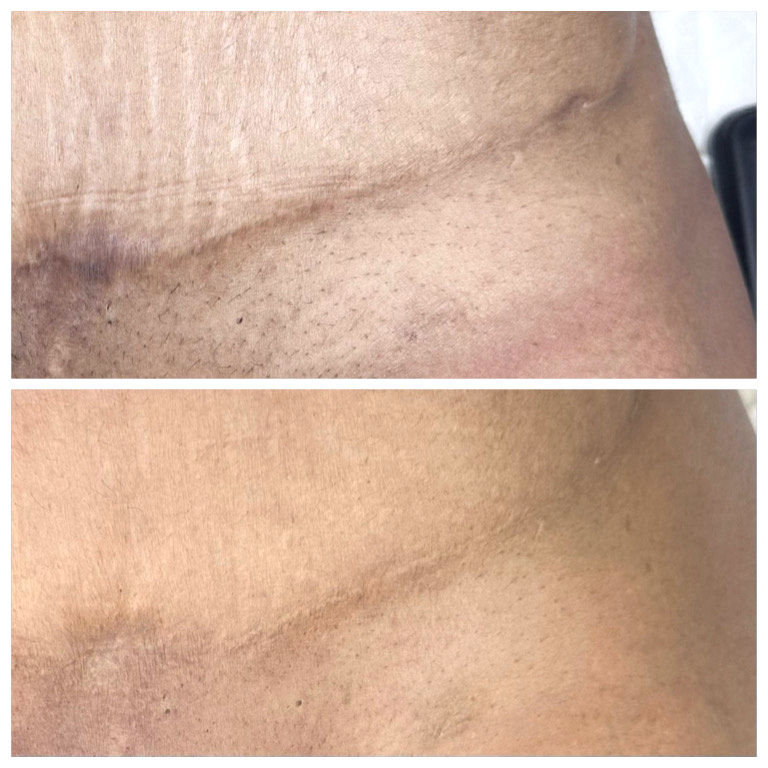
Scar camouflage tattooing uses custom skin tone pigments blended to match your natural color, carefully placed into the mature scar so it blends with the surrounding skin and becomes far less noticeable. Inframammary, periareolar, and armpit scars can all be considered, as long as they are healed and flat.
To be honest about outcomes, camouflage covers and blends a scar. It does not remove it, and results vary depending on the scar's color, texture, and your skin. But for a flat, healed, lighter than skin augmentation scar, blending the color in can make a meaningful difference in how visible it is.
The areola incision and areola color
Because the periareolar incision sits at the areola border, augmentation can sometimes leave the areola looking lighter, patchy, or slightly uneven around that edge. When the concern is color at the areola rather than only the scar line, areola repigmentation is the process that restores and evens that color. Scar camouflage and areola repigmentation can often be done together, and your consultation will determine the right combination for a natural result.
Which augmentation scars are good candidates
Camouflage works best on scars that are fully healed, flat, and no longer pink or red. For an augmentation, this often means waiting until the scar has matured, frequently around a year, though everyone heals differently. A scar that is still red, raised, or changing is not ready. A raised or thick scar is assessed separately, since camouflage is best suited to flat scars.
Color matching and all skin tones
Color accuracy is everything for a fine scar in a visible, delicate area. A pigment that is even slightly off can be more noticeable than the scar was, which is why every case starts with careful color analysis and custom pigment blending matched to your natural tone. Breast augmentation scar camouflage can be done across a wide range of skin tones when the color is matched with this level of care.
What to expect from the process
It begins with a consultation, where your scar and areola are assessed, readiness is confirmed, color options are reviewed, and realistic expectations are set. The procedure involves building color into the scar gradually rather than all at once, keeping the result soft and natural. A follow up perfecting session is typically scheduled around six to eight weeks later, once the skin has healed and the true color has settled, to refine the blend.
Healing and how long it lasts
Healing takes a few weeks per session, during which the area is kept clean and protected and the color settles from its initial intensity. Clear aftercare guidance is provided. Results typically last for years and soften gradually, with occasional touch ups to maintain the blend. Consistent SPF once healed helps protect your results in the Florida sun.
Working with Imagine You New in St. Petersburg, Florida
Imagine You New is a paramedical tattoo studio in St. Petersburg, Florida, led by Bianca Cypser, a licensed esthetician who holds Florida tattoo and establishment licenses and has completed hundreds of documented paramedical tattoo cases. The focus is careful, individualized work and honest expectations. Clients travel to the St. Petersburg studio from across the Tampa Bay area, including Tampa, Clearwater, and Sarasota.
Common questions
How long after breast augmentation can I get scar camouflage?
The scar should be fully healed, flat, and no longer red, which often means waiting around a year, though everyone heals differently. A consultation confirms whether your scar is ready.
Can you camouflage a periareolar or under the breast scar?
Yes. Inframammary, periareolar, and armpit scars can all be considered, as long as they are healed and flat. This is assessed at your consultation.
My areola looks lighter around the incision. Can that be helped?
Often yes. Areola repigmentation restores and evens areola color around the incision, and it can frequently be done alongside scar camouflage. Your consultation determines the best plan.
Will camouflage remove my scar?
No. Camouflage covers and blends the scar so it is much less noticeable. It reduces visibility rather than removing the scar, and results vary by scar and skin type.
Does it work on all skin tones?
Yes. Breast augmentation scar camouflage can be done across a wide range of skin tones, which is why color is always custom matched to your natural undertone.
How long does it last?
Results typically last for years and soften gradually, with occasional touch ups. Sun exposure and skin type affect longevity, so SPF helps protect your results.
If your breast augmentation scar or areola incision has healed but the color still shows, book a consultation at Imagine You New in St. Petersburg, Florida. Call 727-729-9069 or visit imagineyounew.com. Serving St. Petersburg, Tampa, Clearwater, and Sarasota.


Comments