


Thigh Lift Scar Revision Camouflage Tattoo in St. Petersburg, Florida
Thigh lift scar camouflage is a paramedical tattooing technique that deposits custom blended, skin tone pigment into a healed thighplasty scar so the scar is covered and blends into the surrounding skin. At Imagine You New in St. Petersburg, Florida, Bianca Cypser works with inner thigh, groin crease, and vertical thigh lift scars, along with the connecting scars left by lower body lift surgery.
Clients come to the St. Petersburg studio from Tampa, Clearwater, Sarasota, Bradenton, and Orlando, and travel in from Miami, Jacksonville, Fort Lauderdale, and Tallahassee. Paramedical scar camouflage is a specialty rather than something offered at every studio, which is why clients are willing to drive for it. Bianca has completed hundreds of documented paramedical tattoo cases across every category of surgical scar.
What Thigh Lift Scar Camouflage Actually Does
Scar camouflage corrects color. A thigh lift scar that reads pink, red, purple, brown, or bright white against the surrounding skin is noticeable because of contrast. Custom blended pigment matched to your undertone is worked into the mature scar to reduce that contrast so the line stops drawing the eye.
This is a color treatment rather than a texture treatment. If your scar is raised, wide, or hypertrophic, the texture will still be there after camouflage. Many clients address texture first with silicone therapy, steroid injections, or laser through their surgeon or dermatologist, then come in for color work once the scar is flat and stable.
There is a secondary effect worth knowing about. The needling involved in the process breaks up scar tissue and encourages new collagen, so many clients notice the scar feels softer and looks slightly smoother afterward. That is a bonus, not the purpose, and it is not a substitute for medical texture treatment.
The goal is simple. You put on shorts or a swimsuit and the scar is no longer the first thing you or anyone else sees.
Thigh Lift Surgery Types and the Scars They Leave
Thigh lift surgery, also called thighplasty, comes in several forms. Each one places the scar in a different spot, and each one is approached differently for camouflage. These are the surgeries seen most often at the St. Petersburg studio.
Mini thigh lift
A short incision confined to the groin crease where the thigh meets the body. This produces the smallest thigh lift scar and the crease naturally conceals much of it. Camouflage here is focused work and often completes in fewer sessions than other thigh lift scars.
Medial thigh lift, also called an inner thigh lift or crescentic lift
The most common version. The incision sits in the groin crease, and some medial lifts stop there while others extend down the inner thigh. Because the crease hides part of the line, camouflage often concentrates on the portion that shows in shorts and swimwear.
Extended medial thigh lift and vertical thighplasty
Used when more skin needs to come off, most often after significant weight loss. The scar runs vertically down the inner thigh, sometimes from the groin all the way toward the knee. This is the most visible thigh lift scar and the one clients most often want blended. The full length is treated in sections across a series of sessions rather than all at once.
Lateral thigh lift, also called an outer thigh lift
The incision runs around the hip from the groin, sometimes extending toward the lower back, and may include a buttock crease incision. Because it sits on the outside of the leg where clothing covers less reliably, this scar tends to be more exposed than an inner thigh scar and is a strong camouflage candidate.
Spiral thigh lift
A comprehensive lift addressing the inner, outer, front, and back of the thigh, often as part of full lower body contouring. The scar path wraps the thigh, so camouflage is planned in stages so each treated section heals before the next begins.
Thigh lift combined with a lower body lift or belt lipectomy
When a thigh lift is performed alongside a body lift, the scars can connect and run continuously around the torso and down the leg. Camouflage can address the thigh portion and the connecting lines in coordinated sessions.
Thigh Scars After Massive Weight Loss
Clients who have had gastric bypass, gastric sleeve, duodenal switch, or other bariatric surgery often go through several body contouring procedures. Thigh lift scars usually arrive alongside arm lift, tummy tuck, panniculectomy, breast lift, and body lift scars.
These scars are strong camouflage candidates once fully matured. The work is sequenced so each area is treated and healed before moving to the next, which keeps healing manageable and lets us judge how your skin holds pigment before committing to a larger area.
Many weight loss clients treat their thigh scars over a series of months alongside other areas, rather than trying to address everything at once.
When Your Thigh Lift Scar Is Ready
A thigh lift scar is not ready for camouflage the moment it closes. Scars go through a maturation process, and the color you see at three months is not the color you will have at eighteen months.
Most scars look their worst somewhere between month two and month four, when collagen remodeling thickens the line and deepens the color. From there the scar gradually softens, flattens, and fades. Full maturation typically takes twelve to eighteen months, and for some people longer.
Camouflage is done on mature scars, generally at least twelve months old and fully healed, with no open areas, scabbing, or active irritation. Working on an immature scar risks uneven pigment retention and a result that shifts as the scar continues to change underneath it.
If revision surgery is still on the table, wait. Any future surgery on that line will cut through the camouflage work.
Sun exposure matters more than most people expect in Florida. UV exposure during the first year of healing can lock in darker or redder tones that would have faded in a less intense climate. Keeping a healing thigh scar covered or protected is one of the most useful things you can do for the eventual camouflage result.
Hyperpigmented and Hypopigmented Thigh Scars
Thigh lift scars fall into two broad color problems, and they are handled differently.
Hyperpigmented scars read darker than the surrounding skin, often brown or purple. These are more common in deeper skin tones and in scars that saw sun during healing. Dark scars frequently need a lightening process before camouflage pigment is applied, because depositing skin tone pigment over a dark line without addressing the darkness first does not produce a natural blend.
Hypopigmented scars read lighter than the surrounding skin and often appear white or silvery. These are the classic mature thigh lift scars people describe as thin white lines. Camouflage adds pigment back into skin that lost it, bringing the line up to match the tone around it.
Red and purple scars are a third category. These usually indicate the scar is still maturing and blood vessels are still prominent. Red scars are generally asked to wait longer, since color continues to change on its own.
Both hyperpigmented and hypopigmented scars respond to camouflage. Which process you need is determined at consultation by assessing the scar in person under proper lighting.
Skin Tone and Pigment Matching
Camouflage works across all skin tones. Getting a natural result depends entirely on pigment matching, which is why the pigment is custom blended for each client rather than pulled from a stock bottle.
The blending process works much like matching foundation. Several pigment options are swatched against your skin to find the combination that reads correctly against your undertone, not just your surface tone. Undertone is what makes the difference between a blend that disappears into the leg and one that reads slightly off.
Deeper skin tones often benefit most from the combination of a lightening process followed by camouflage, because dark scars stand out sharply and the improvement is significant. Lighter skin tones with white hypopigmented scars are usually a more direct color replacement.
A test patch is standard practice. It shows how your skin accepts and heals the pigment before larger areas are treated, and it is especially useful on a long vertical scar where the treated area will eventually be extensive.
What the Process Looks Like
Every case begins with a consultation where the scar is assessed for age, texture, color, and skin type. Not every scar is a candidate, and you will be told honestly if yours is not ready or not suitable.
From there the work is layered rather than done in one pass. Pigment is built up gradually, allowed to heal, and evaluated before more is added. Building slowly is what produces a natural blend, and it is why scar camouflage cannot be rushed.
Sessions are typically spaced six to eight weeks apart to allow full healing between appointments. Most clients need multiple sessions. A short mini thigh lift scar takes fewer, while a full vertical thighplasty scar running toward the knee is treated in sections and takes longer.
Immediately after a session the treated area typically looks darker or more pronounced than the final result. That is expected. A meaningful portion of the pigment lifts away during the first week to ten days of healing, which is exactly why the work is layered rather than saturated in one sitting.
Healing and Aftercare
Healing on the thigh has its own considerations. The inner thighs naturally rub together, which creates friction on a healing treated area, and Florida heat means sweating is harder to avoid than it would be elsewhere. Both are worth planning around.
The general healing pattern runs like this. The first few days the area looks darker and may feel tender. Days four through ten bring light flaking or peeling as the skin recovers. Over weeks two through four the pigment settles and softens. Final healed color is usually visible somewhere around the six to eight week mark, which is also when the next session is scheduled.
During healing, the things that most commonly compromise a result are heavy sweating, submerging the area in water, sun exposure, and picking at flaking skin. Each of those pulls pigment out or shifts color. Specific aftercare instructions are given at your appointment and are tailored to the size and location of your treated area.
Once healed, sun protection on the treated area does more to extend your results than anything else. Given the UV index in the Tampa Bay area, that matters here more than it would in most of the country.
What Affects the Cost of Thigh Lift Scar Camouflage
Scar camouflage is priced by the work involved rather than by a flat rate, because a two inch groin crease scar and a full vertical scar running to the knee are not the same job.
The factors that determine your quote:
Length and surface area of the scar
Whether it is one scar or several, such as a thigh lift combined with a body lift
Age and maturity of the scar
Whether the scar is hyperpigmented and needs a lightening process before camouflage
Texture of the scar and whether preparatory work is needed
How many sessions your skin is likely to need based on how it holds pigment
Because the number of sessions varies by person, pricing is discussed at consultation once the scar has been assessed in person. Beware of a quote given without anyone seeing the scar.
Longevity and Maintenance
Camouflage results are long lasting but not permanent. Pigment softens gradually over the years as skin renews itself and sun exposure accumulates, which happens faster in Florida than in most of the country.
Many clients enjoy their results for years and come back for an occasional refresh session to keep the blend looking right. That is normal and expected, not a sign that anything went wrong.
A few things fade pigment faster than normal aging. Chemical exfoliants, retinol, and acid products used on the treated area will lift pigment prematurely. Laser treatments over camouflaged skin can alter the pigment color and should be avoided on treated areas. Tanning, whether outdoors or in a bed, is the single fastest way to lose a result.
Frequently Asked Questions About Thigh Lift Scar Camouflage
Can you tattoo over a thigh lift scar?
Yes. Mature thigh lift scars that are fully healed can be covered with paramedical camouflage tattooing using custom blended, skin tone pigment. The scar is assessed at consultation for age, texture, and color to confirm it is a candidate.
How long do I have to wait after thigh lift surgery?
Generally at least twelve months. Thigh lift scars take twelve to eighteen months to fully mature, and camouflage is done on a mature, stable scar. If you are still considering revision surgery, wait until that decision is settled.
Why do I have to wait so long?
Because the scar is still changing. Color, thickness, and texture continue to shift during the first year. Pigment placed into a scar that is still remodeling can heal unevenly or shift as the tissue underneath it changes.
Will camouflage work on a vertical inner thigh scar that runs to my knee?
Yes. Long vertical thighplasty scars are among the most requested cases. The scar is treated in sections across a series of sessions rather than all at once so each area heals properly.
Does scar camouflage fix a raised or wide thigh scar?
No. Camouflage addresses color rather than texture. Raised, wide, or hypertrophic scars usually respond better if texture is treated first through your surgeon or dermatologist. Once the scar is flat and stable, color camouflage produces the most natural result.
Does it work on dark skin?
Yes. Pigment is custom blended and matched to your undertone, which is what makes natural results possible across all skin tones. Deeper skin tones with hyperpigmented scars often benefit from a lightening process before camouflage pigment is applied.
My thigh scar is darker than my skin. Can that be treated?
Yes. Hyperpigmented scars generally need a lightening process first, then camouflage pigment. Applying skin tone pigment directly over a dark scar without addressing the darkness does not produce a natural blend.
My thigh scar is white. Is that easier?
Hypopigmented white scars are usually a more direct color replacement, since the goal is adding pigment back into skin that lost it. They still require layering and multiple sessions.
My scar is still red. Can I get it done?
Usually not yet. A red or purple scar generally means it is still maturing and blood vessels are still prominent. That color often improves on its own, so waiting is typically the better call.
How many sessions will I need?
It depends on the length of the scar and how your skin holds pigment. A short groin crease scar takes fewer sessions than a full vertical scar running toward the knee. Multiple sessions are standard and they are spaced six to eight weeks apart to allow full healing.
How far apart are sessions?
Typically six to eight weeks. That gives the treated area time to fully heal so the healed color can be evaluated before the next layer is added.
Does it hurt?
Advanced numbing is used and most clients report minimal discomfort. The inner thigh is a sensitive area and that is accounted for during the session.
What does the healing look like?
The area appears darker for the first few days, then goes through light flaking or peeling roughly days four through ten. Pigment settles and softens over the following weeks, with healed color usually visible around six to eight weeks.
Will the color look too dark at first?
Yes, and that is normal. A meaningful portion of pigment lifts during the first week to ten days of healing. The color you see immediately after a session is not the color you keep, which is why the work is layered.
What do I need to avoid while it heals?
Heavy sweating, swimming and soaking, sun exposure, tight clothing over the area, and picking at flaking skin. Each of those can pull pigment out or shift the color. Full instructions are given at your appointment.
Can I work out after a session?
Not right away. Heavy sweating during early healing dilutes pigment and can pull it out. You will be given a specific timeline based on your treated area.
How long do results last?
Results are long lasting but not permanent. Pigment softens over the years with natural skin renewal and sun exposure. Many clients return for a refresh session periodically.
What makes camouflage fade faster?
Sun exposure and tanning are the biggest factors, especially in Florida. Retinol, acids, and chemical exfoliants used over the treated area will also lift pigment prematurely. Laser treatments over camouflaged skin can alter the pigment color.
How much does thigh lift scar camouflage cost?
Pricing depends on the length and surface area of the scar, whether lightening is needed first, and how many sessions your skin is likely to require. Because those factors vary widely, cost is discussed at consultation once the scar has been assessed in person.
Can I get camouflage if my thigh lift scar connects to a body lift scar?
Yes. Connecting scars from a lower body lift or belt lipectomy can be addressed alongside the thigh portion in coordinated sessions.
Do you treat thigh lift scars from surgery done somewhere else?
Yes. Where your surgery was performed does not matter. What matters is the age, color, and texture of the scar.
Can I get this done if I am pregnant or breastfeeding?
No. Paramedical tattooing is not performed during pregnancy or while breastfeeding.
I have several scars from weight loss surgery.
Can they all be treated?
Yes, and most weight loss clients do exactly that. The work is sequenced across a series of appointments so each area heals before the next begins, rather than treating everything at once.
How do I know if my scar is a candidate?
The only reliable way is an in person assessment. Age, color, texture, and skin type all factor in, and a scar that looks straightforward in a photo can behave differently in person.
Serving St. Petersburg and Across Florida
Imagine You New is located at 4137 Fifth Avenue North in St. Petersburg, Florida. The studio is home base for clients across St. Petersburg, Tampa, Clearwater, Sarasota, Largo, Bradenton, Pinellas Park, Seminole, Palm Harbor, and Brandon, and welcomes clients traveling from Orlando, Miami, Jacksonville, Fort Lauderdale, Naples, Fort Myers, Tallahassee, and Gainesville.
To find out whether your thigh lift scar is a candidate, book a consultation. Call 727-729-9069 or request an appointment through the website.


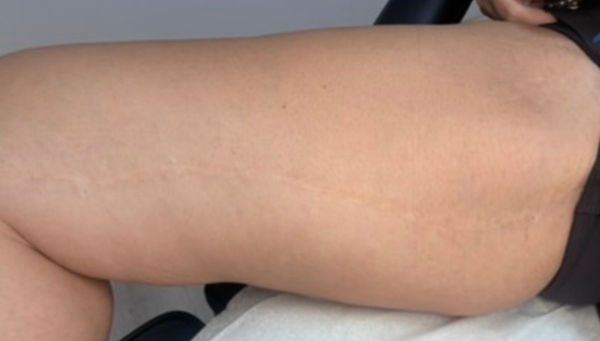
Thigh Lift Scar Revision Camouflage Tattoo in St. Petersburg, Florida
A lot of people want to get the thigh lift, but then after that's done, they're left with a scar. So they have to get it taken care of.
What Thigh Lift Scars Look Like When Clients Come to Me
Most likely white. Hypopigmented and white and long. Sometimes really thick and bumpy, sometimes a very thin line. Sometimes a thin line with hyperpigmentation around it, or inside the scar, mostly around it.
They want to wear dresses, they want to wear bathing suits. They're just not happy with the look.
How I Work on Thick, Bumpy Thigh Lift Scars
I change the needles, I change the depth, how I work on it. I might do some microneedling sessions prior. It just depends.
Dark Hyperpigmentation Around a Thigh Lift Scar
When there's dark hyperpigmentation around the scar, I lighten that area in the first couple sessions first, before working on the whole scar.
Already Tried Laser Scar Revision and Your Scar Is Still White?
I can definitely get it to look like your skin tone color. Not a problem at all. I feel very confident in my work.
Thigh Lift Scars After 1 Year, 2 Years and Longer
I like to wait about a year after surgery. And older scars are not a problem. I can help two years, three years, four years, five years after surgery.
How Many Sessions Does a Thigh Lift Scar Take?
About eight to ten sessions. It depends on the scar and the thickness of the scar.
Does It Hurt?
No. I numb really well.
Aftercare for 14 Days After Each Session
No heavy sweating. You cannot be running or going for fast walks. You don't want any sweating in those creases between the legs or in the groin area, because sometimes the scar goes up that high. And don't be soaking in water or swimming.
Will Insurance Pay for Thigh Lift Scar Revision?
I don't bill insurance directly. You'd have to ask your insurance.
Thigh Lift Scar Camouflage Cost
I offer a session price and a project price. Financing is available through the Apply for Financing link on my site.
How Clients Feel
They're so happy. They want to wear skirts. They want to go swimming. They want to feel like just their regular leg. They don't want to feel like they have a big scar on their leg.
Thigh Lift Scar Tattoo Near Me in St. Petersburg, Tampa, Clearwater and Sarasota
If you'd like to come in for a consultation first, you can. If you'd rather just book your first appointment, that's okay too.
Book at imagineyounew.com
Do Thigh Lifts Leave Scars?
Yes. A thigh lift leaves a scar in the groin crease, down the inner thigh, or around the hip, depending on the type of thigh lift. Most clients come to me with a white, hypopigmented scar, and some come with a dark thigh lift scar or dark hyperpigmentation around it.
Is This Scar Removal?
No treatment removes a thigh lift scar completely. What I do is camouflage it, so the color blends into your skin and it doesn't look like you have a big scar on your leg.
Thigh Lift Scars Before and After
You can see my thigh lift scar before and after pictures below.
Thigh lift scar revision doesn't have to mean another surgery. Scar revision camouflage tattoo is a non-surgical scar revision, so you can get scar revision without surgery and without more downtime from another procedure. If you already tried laser scar revision and your scar is still white, I can definitely get it to look like your skin tone color. A scar revision tattoo blends the color of your thigh lift scar into the skin around it, whether it's white, dark, thick or a thin line. If you're searching for scar revision near me, my studio is in St. Petersburg, Florida, and clients come from Tampa, Clearwater and Sarasota. For thigh lift scar revision cost, I offer a session price and a project price.